
A badly damaged, cracked, heavily filled, worn, or root-canal-treated tooth may need more protection than a normal filling can provide. In such cases, a dental crown can help restore the tooth’s shape, strength, function, and appearance.
If you are researching dental crown cost in Chembur, the final amount can vary considerably depending on the crown material, the tooth being treated, laboratory work, whether root canal treatment is required, and the condition of the remaining tooth.
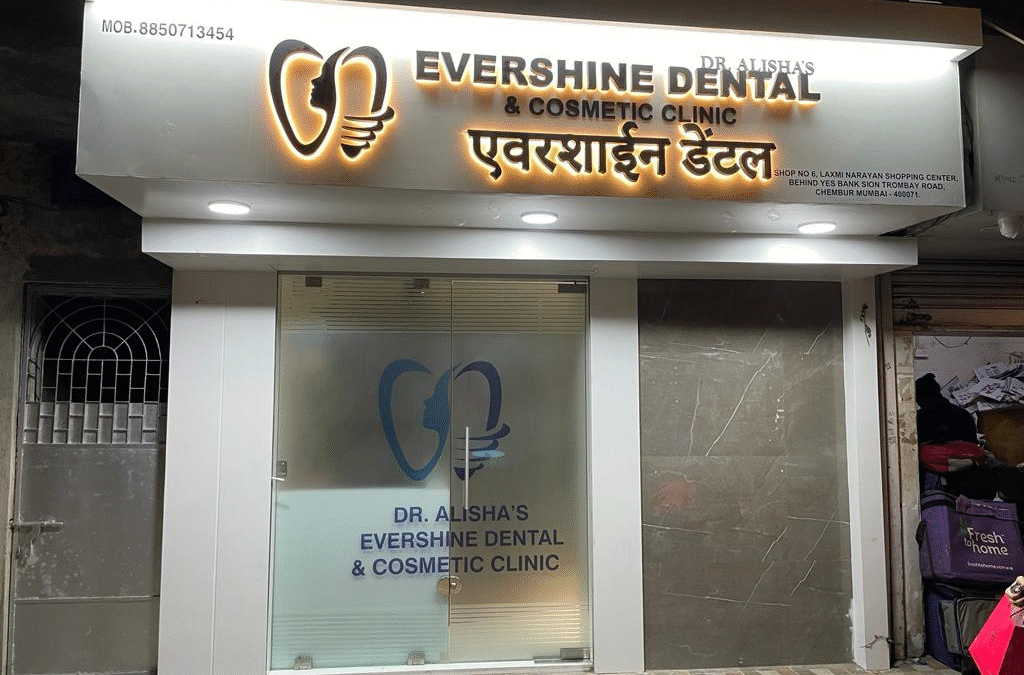
At Dr. Alisha’s Evershine Dental & Cosmetic Clinic, restorative dental treatment includes options for damaged teeth, root canal treatment, cosmetic dentistry, and other dental procedures.
This guide explains the main types of dental crowns, expected costs, the dental crown procedure, crowns after root canal treatment, how long crowns last, and how to decide between zirconia, ceramic, porcelain, and metal options.
What Is a Dental Crown?
A dental crown, often called a dental cap, is a restoration that covers most or all of the visible portion of a natural tooth.
The NHS describes a crown as a cap that completely covers a real tooth and notes that crowns can be used when a tooth is broken, decayed, damaged, or needs an improvement in appearance.
A crown may be recommended to:
- Protect a weakened tooth
- Restore a broken tooth
- Cover a heavily filled tooth
- Strengthen a tooth after root canal treatment
- Improve the shape or appearance of a tooth
- Restore a worn tooth
- Cover an implant as part of an implant restoration
Because the crown becomes part of your bite, its material, fit, shape, and design are important.
Dental Crown Cost in Chembur
One of the most common patient questions is: How much does a dental crown cost in Chembur?
There is no single universal price because the dental crown cost in Chembur depends heavily on the type of crown and complexity of treatment.
The overall tooth crown cost in Chembur may be influenced by:
- Crown material
- Tooth location
- Amount of tooth damage
- Need for root canal treatment
- Need for a core build-up or post
- Laboratory charges
- Cosmetic requirements
- Digital scanning or impressions
- Number of crowns
- Whether a temporary crown is required
This means the dental cap cost in Chembur should ideally be discussed after the tooth has been examined.
What Affects Dental Crown Cost?
Crown Material
A basic metal crown and a high-aesthetic zirconia or ceramic crown can have different costs.
Tooth Location
Front teeth often require greater cosmetic attention because they are visible when smiling.
Back teeth need to withstand stronger chewing forces.
Condition of the Tooth
A mildly damaged tooth may need less preparation than a tooth that is:
- Severely broken
- Heavily decayed
- Root canal treated
- Structurally weak
Root Canal Treatment
If the tooth needs RCT before crown placement, the total cost increases.
Additional Build-Up
Sometimes the remaining tooth structure is not sufficient to support a crown without additional restorative work.
Types of Dental Crowns
There are several types of dental crowns, and each has its own advantages and limitations.
Common options include:
- Zirconia crowns
- Ceramic crowns
- Porcelain crowns
- Porcelain-fused-to-metal crowns
- Metal crowns
The most appropriate choice depends on strength, appearance, tooth position, bite, and budget.
Zirconia Crowns
Zirconia is a strong ceramic material commonly used for dental crowns.
Patients searching for zirconia crown cost in Chembur often choose this option because zirconia can combine strength with a tooth-coloured appearance.
Potential advantages include:
- High strength
- Tooth-coloured appearance
- Good durability
- Suitable for many back teeth
- Can also be used in cosmetic areas depending on the type of zirconia
The exact appearance depends on the zirconia system used.
Highly translucent zirconia may be chosen in more visible areas, while stronger varieties may be selected for back teeth.
Ceramic Crowns
Ceramic crowns are commonly chosen for their natural appearance.
Potential benefits include:
- Good aesthetics
- No visible metal
- Tooth-like colour
- Suitable for visible teeth in many cases
The ceramic crown cost in Chembur may vary depending on the ceramic system and laboratory work involved.
Ceramic materials differ in strength and translucency, so the best option depends on where the crown will be placed.
Porcelain Crowns
Porcelain crowns are commonly associated with high aesthetic quality.
A porcelain crown cost in Chembur may be higher than basic metal options because cosmetic laboratory work can be more demanding.
Porcelain can provide:
- Natural-looking shade
- Good translucency
- Good cosmetic integration with neighbouring teeth
However, material choice should consider both beauty and bite forces.
Metal Crowns
Metal crowns have been used in dentistry for many years.
They are typically strong and resistant to fracture.
Possible advantages include:
- High durability
- Good strength
- Suitable for strong chewing forces
Their main disadvantage is appearance because they do not match the natural tooth colour.
For this reason, metal crowns are more commonly considered for less visible teeth.
The metal crown cost in Chembur can differ from zirconia or ceramic options depending on the alloy and treatment plan.
Porcelain-Fused-to-Metal Crowns
Porcelain-fused-to-metal, often called PFM, combines a metal base with a tooth-coloured porcelain outer layer.
These crowns have historically been widely used because they provide strength from the metal structure with a more natural appearance than a completely metal crown.
However, some patients prefer newer all-ceramic or zirconia restorations for visible teeth because there is no underlying metal.
Zirconia vs Ceramic Crown
Patients frequently compare zirconia vs ceramic crown options.
Zirconia may be preferred when:
- Strength is a major priority
- The crown is on a back tooth
- The patient has a strong bite
- Durability is important
Ceramic may be preferred when:
- Maximum aesthetics are important
- The tooth is highly visible
- The dentist wants a particular level of translucency
However, modern zirconia can also provide very good aesthetics.
The choice should therefore be based on the individual tooth rather than simply assuming one material is always better.
Porcelain vs Zirconia Crown
The porcelain vs zirconia crown comparison is similar.
Porcelain can provide excellent translucency and a very natural appearance.
Zirconia often offers greater strength.
For some front teeth, aesthetic ceramic options may be chosen.
For back teeth, zirconia may be recommended when strength is especially important.
The final decision should consider:
- Tooth position
- Bite
- Available tooth structure
- Opposing teeth
- Cosmetic goals
- Grinding habits
Which Dental Crown Is Best?
There is no universal best dental crown in Chembur for every patient.
The best choice depends on the clinical situation.
For example:
- A back molar may require greater strength.
- A front tooth may require greater translucency.
- A patient who grinds teeth may need a particularly durable material.
- A cosmetic case may need careful shade matching.
- A severely damaged tooth may require additional strengthening before crown placement.
A dental crown dentist in Chembur should therefore recommend a material after examining the individual tooth.
Which Dental Crown Is Best for Front Teeth?
For patients asking which dental crown is best for front teeth?, aesthetics are often the main priority.
Options such as:
- High-quality ceramic
- Porcelain
- Translucent zirconia
may be considered depending on the case.
A front crown should ideally match neighbouring teeth in:
- Colour
- Shape
- Size
- Surface texture
- Translucency
Cosmetic matching is especially important when only one front tooth is being crowned.
Which Crown Is Best for Back Teeth?
Back teeth experience higher chewing pressure.
For molars and premolars, dentists often prioritise:
- Strength
- Fracture resistance
- Bite stability
- Long-term durability
Zirconia or other strong restorative materials may therefore be considered.
However, the best option still depends on the individual bite and amount of remaining tooth structure.
Dental Crown After Root Canal Treatment
A dental crown after root canal treatment is commonly recommended, particularly for back teeth.
Root canal treatment removes infected tissue from inside the tooth, but the tooth may already have lost substantial structure because of:
- Decay
- Previous fillings
- Access created during RCT
- Cracks
- Existing damage
An NHS hospital guide notes that crowns may be used following root canal treatment to restore weakened teeth.
A crown can help protect the remaining tooth from further fracture.
Which Crown Is Best After Root Canal?
The answer to which crown is best after root canal? depends on the tooth.
For a back tooth, strength is usually especially important.
For a front tooth, aesthetics may be a greater priority.
Possible materials include:
- Zirconia
- Ceramic
- Porcelain-based restorations
- PFM
- Metal in selected situations
Your dentist should also assess how much natural tooth remains before deciding whether additional support is required.
Crown After Root Canal Cost in Chembur
The crown after root canal cost in Chembur generally includes a separate crown fee in addition to the root canal treatment itself.
This is important when comparing treatment quotations.
Ask whether your treatment estimate includes:
- Root canal treatment
- Temporary restoration
- Core build-up if needed
- Final crown
- Laboratory charges
- Follow-up appointments
The root canal and crown cost is therefore not the same as the cost of RCT alone.
Crown for Broken Tooth
A crown for a broken tooth may be recommended when enough healthy tooth remains to support a restoration.
A crown can:
- Cover the damaged tooth
- Restore its shape
- Improve chewing
- Protect weakened structure
However, not every broken tooth can be saved.
If the fracture extends deeply below the gum or into the root, another treatment may be necessary.
Crown for Damaged Tooth
A crown for a damaged tooth may also be used when a large amount of tooth structure has been lost through decay or previous restorations.
Cleveland Clinic notes that crowns are commonly used to repair large cavities and restore broken teeth.
The amount of healthy tooth remaining determines whether a crown is appropriate.
Dental Cap for Front Teeth
A dental cap for front teeth must provide more than strength.
It should also look natural.
Your dentist may consider:
- Tooth shade
- Shape
- Gum line
- Facial symmetry
- Neighbouring teeth
- Smile line
Front crowns may require additional cosmetic planning because small colour differences can be noticeable.
Dental Crown Procedure
The dental crown procedure commonly takes place over one or more appointments depending on the crown system used.
A traditional laboratory-made crown procedure often involves the following steps.
1. Dental Examination
The dentist first checks the tooth.
This may include:
- Clinical examination
- X-rays
- Checking for decay
- Assessing the root
- Evaluating existing fillings
- Checking the bite
If the tooth has an infection, root canal treatment may be required first.
2. Tooth Preparation
The tooth is reshaped to create enough space for the crown.
The NHS notes that the tooth usually needs to be shaped before the crown can be fixed over it.
This allows the final crown to fit properly without making the tooth excessively bulky.
3. Impression or Digital Scan
The prepared tooth and surrounding teeth are recorded.
This may be done using:
- Traditional dental impressions
- Digital intraoral scanning
The information is then used to manufacture the crown.
4. Temporary Crown
For laboratory-made crowns, a temporary crown may be placed while the final restoration is being produced.
Leeds Teaching Hospitals notes that crown treatment traditionally involves preparing the tooth, taking an impression and placing a temporary crown before the final crown is fitted later.
5. Final Crown Placement
When the final crown is ready, the dentist checks:
- Fit
- Shape
- Colour
- Bite
- Contact with neighbouring teeth
Once everything is satisfactory, the crown is cemented or bonded in place.
Does Getting a Dental Crown Hurt?
Patients often ask: Does getting a dental crown hurt?
The tooth is usually numbed with local anaesthesia during preparation, so the procedure itself should generally be comfortable.
After the anaesthetic wears off, patients may temporarily experience:
- Mild gum soreness
- Tooth sensitivity
- Bite awareness
These symptoms often improve.
If pain is severe, persistent, or becomes worse, the crown and underlying tooth should be assessed.
How Long Does Crown Treatment Take?
Traditional crown treatment may require two main appointments.
The first appointment typically involves:
- Tooth preparation
- Impression or scan
- Temporary crown
The second appointment involves fitting the final crown.
Leeds Teaching Hospitals states that crowns traditionally involve two visits, with the permanent restoration fitted after laboratory fabrication.
Some modern clinics may also use digital workflows that can alter the treatment timeline.
How Long Does a Dental Crown Last?
One of the most common questions is: How long does a dental crown last?
A crown is a long-term restoration, but it does not necessarily last forever.
Cleveland Clinic gives an average crown lifespan of about 5 to 15 years, although some crowns can last longer with good care.
The dental crown lifespan depends on:
- Crown material
- Oral hygiene
- Bite forces
- Tooth grinding
- Gum health
- Decay around the crown
- Diet
- Regular dental examinations
What Can Shorten a Crown’s Lifespan?
A crown may fail earlier because of:
- Tooth decay underneath or around it
- Gum disease
- Heavy grinding
- Cracks or fractures
- Biting hard objects
- Cement failure
- Trauma
- Poor oral hygiene
The natural tooth underneath the crown still requires care.
Dental Crown Replacement
Dental crown replacement may become necessary when:
- The crown fractures
- The crown becomes loose
- Decay develops underneath
- The gum line changes significantly
- The crown becomes worn
- The appearance needs correction
- The underlying tooth develops a problem
An old crown should not be replaced automatically just because of age.
The dentist should assess its condition first.
Can a Crown Get a Cavity?
The crown material itself cannot develop tooth decay.
However, the natural tooth beneath and around the crown margins can.
Plaque can collect where the crown meets the natural tooth.
That is why brushing and flossing remain essential after crown placement.
How to Care for a Dental Crown
Good care can improve crown longevity.
Brush Twice Daily
Brush the crown and gum line carefully just as you would natural teeth.
Floss Every Day
Clean between the crowned tooth and neighbouring teeth.
Avoid Using Teeth as Tools
Do not bite:
- Bottle caps
- Packaging
- Very hard objects
Manage Tooth Grinding
Patients who clench or grind may benefit from a protective night guard.
Attend Dental Checkups
Routine reviews allow your dentist to assess:
- Crown margins
- Bite
- Gum health
- Decay
- Wear
Can You Eat Normally With a Crown?
Once the final crown is securely fitted and the dentist has confirmed that the bite is correct, patients can generally use the tooth normally.
However, it is sensible to avoid repeatedly chewing extremely hard items because crowns can still fracture.
Temporary crowns require more caution because they are not designed to provide the same long-term strength as the final restoration.
Dental Crown vs Filling
A filling restores part of a tooth.
A crown covers most or all of the visible tooth structure.
A filling may be enough for:
- Small or moderate cavities
- Localised damage
A crown may be recommended when:
- A large amount of tooth structure is missing
- The tooth is cracked
- A large filling has weakened the tooth
- The tooth has undergone root canal treatment
The dentist should preserve as much natural tooth as reasonably possible.
Dental Crown vs Veneer
A veneer mainly covers the visible front surface of a tooth.
A crown covers much more of the tooth.
Veneers are generally more cosmetic, whereas crowns are often selected when significant structural reinforcement is needed.
For a healthy front tooth with a cosmetic concern, a veneer may sometimes be considered.
For a heavily damaged tooth, a crown may be more appropriate.
Dental Crown vs Dental Implant
A crown and a dental implant are not the same thing.
A crown can be placed over:
- A natural tooth
- A dental implant
If the natural tooth can be predictably restored, a crown may allow it to remain.
If the tooth cannot be saved and must be removed, an implant-supported crown may eventually be considered.
Evershine Clinic lists dental implants among its available dental treatments in Chembur.
Is Zirconia Better Than Ceramic?
For patients asking is zirconia better than ceramic?, neither material is automatically superior.
Zirconia may offer:
- Greater strength
- Good durability
- Suitability for strong biting forces
Some ceramic systems may offer:
- Excellent translucency
- Highly natural aesthetics
- Benefits in visible front teeth
The appropriate material depends on the individual tooth and treatment goals.
Choosing a Dental Crown Dentist in Chembur
When choosing a dental crown dentist in Chembur, consider more than just the lowest crown price.
A good restorative assessment should include:
- Examination of the underlying tooth
- Appropriate X-rays when necessary
- Bite assessment
- Discussion of material choices
- Explanation of advantages and limitations
- Transparent pricing
- Proper shade selection
- Follow-up care
Patients can visit Dr. Alisha’s Evershine Dental & Cosmetic Clinic for restorative, root canal, cosmetic, implant and other dental treatment options in Chembur East.
Frequently Asked Questions
How much does a dental crown cost in Chembur?
The dental crown cost in Chembur depends on the material, tooth location, laboratory work, condition of the tooth and whether additional treatment such as root canal therapy or a core build-up is required. A clinical examination is needed for an accurate estimate.
Which dental crown is best for front teeth?
Ceramic, porcelain, or aesthetic zirconia may be considered for front teeth because appearance is especially important. The best choice depends on the tooth, bite and neighbouring teeth.
Which crown is best after root canal?
The right material depends on the treated tooth. Strength is especially important for molars, while aesthetics may be more important for front teeth. Crowns are commonly used after root canal treatment when the tooth has been significantly weakened.
How long does a dental crown last?
Cleveland Clinic states that the average dental crown lasts approximately 5 to 15 years, although longevity can vary considerably.
Is zirconia better than ceramic?
Not necessarily. Zirconia is often chosen for strength, while some ceramic materials may provide excellent translucency and aesthetics. Your dentist should select the material according to the clinical situation.
Does getting a dental crown hurt?
Local anaesthesia is normally used during tooth preparation. Mild temporary sensitivity or gum soreness can occur afterward.
Is a crown necessary after root canal treatment?
A crown is commonly recommended for structurally weakened teeth, particularly molars and premolars, although the exact restoration depends on how much healthy tooth remains.
Can crowns be used on broken teeth?
Yes, crowns can restore many broken or damaged teeth when enough healthy structure remains to support the restoration.
Do crowns need replacement?
Crowns can eventually require replacement because of wear, fracture, decay, gum changes or problems with the underlying tooth.
Can a cavity develop under a crown?
Yes. The natural tooth can still develop decay around the crown margins, which is why daily oral hygiene remains essential.
Can I get a crown without a root canal?
Yes. Not every crowned tooth needs root canal treatment. RCT is only required when the pulp is significantly inflamed, infected or otherwise requires endodontic treatment.
What is the difference between a crown and a cap?
There is no meaningful difference. “Dental cap” is a common term for a dental crown.
Final Thoughts
The dental crown cost in Chembur depends on the crown material, condition of the tooth, tooth location, cosmetic requirements and whether additional procedures such as root canal treatment are required.
Zirconia, ceramic, porcelain, PFM and metal crowns all have different advantages. There is therefore no single crown material that is best for every patient.
A strong back tooth may need a different restoration from a highly visible front tooth, and a crown following root canal treatment may have different requirements from a purely cosmetic restoration.
If you are considering dental crown treatment in Chembur, you can visit Dr. Alisha’s Evershine Dental & Cosmetic Clinic for an individual assessment and to discuss suitable crown materials, treatment steps and expected costs.